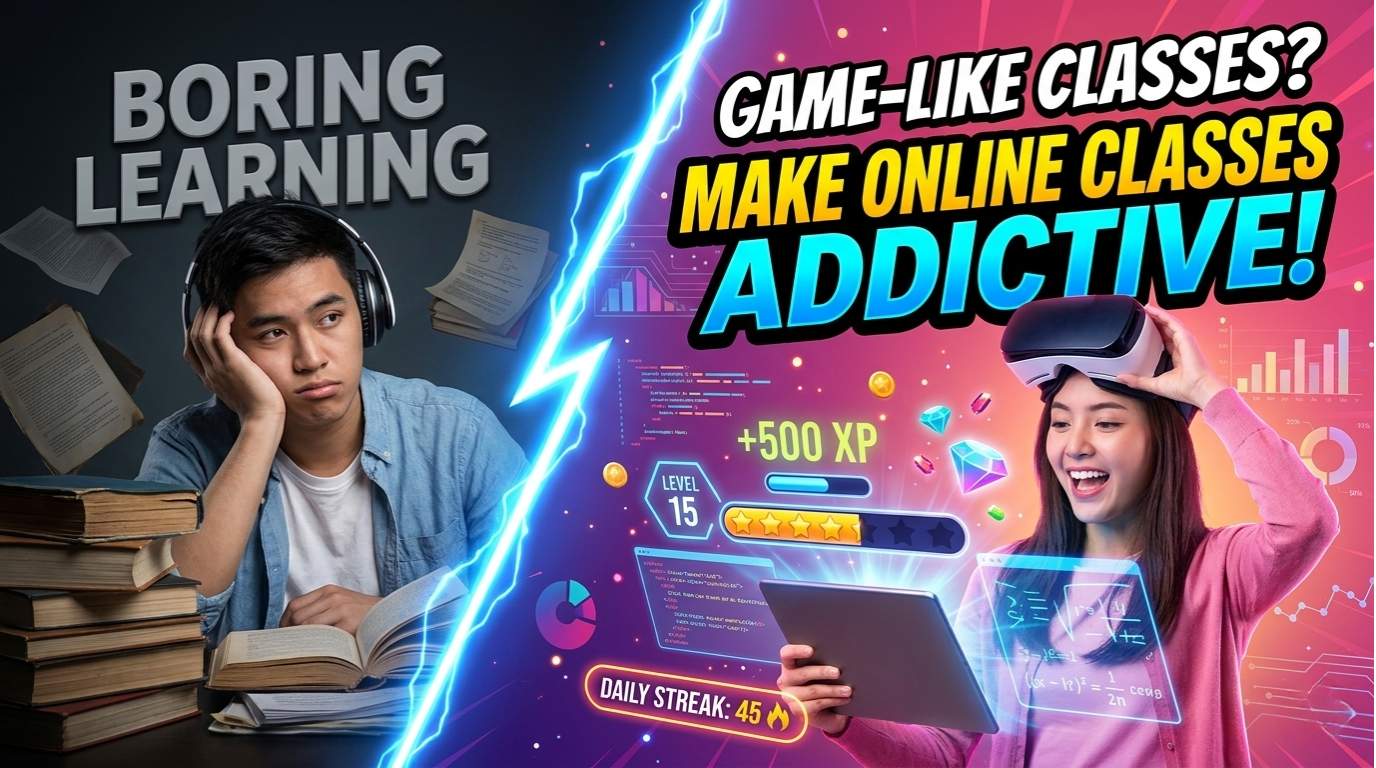
Think about the last time you opened a language app or an online learning platform. Did you find yourself completing “just one more lesson” to save a virtual character, maintain a fire icon next to your username, or climb a weekend leaderboard?
You are not alone. In 2026, the global online education sector has undergone a massive evolution. Platforms have cracked the code to student engagement by adopting tactics from an unlikely industry: video games. This strategy is known as gamification—the integration of game design elements into non-game contexts. It transforms dry, passive learning into an interactive, high-stakes ecosystem. But why does turning a physics lecture or a coding syntax module into a game make it so incredibly addictive? Let’s dive into the fascinating psychology and mechanics behind learning through play.
1. The Dopamine Loop: The Chemistry of “One More Level”
At the heart of every addictive habit lies a neurotransmitter called dopamine. Dopamine is not actually the chemical of pleasure; it is the chemical of anticipation and motivation.
When you play a well-designed video game, your brain receives continuous, micro-doses of dopamine every time you defeat an enemy, find a hidden item, or clear a stage. Gamified online classes replicate this exact neurological process.
-
The Old Way: You submit a 2,000-word essay and wait two weeks for a letter grade. By the time you get the feedback, the dopamine window has closed.
-
The Gamified Way: You complete a short module on advanced algorithms, and the platform instantly rewards you with a “+500 XP” splash screen, a satisfying chime sound effect, and an immediate level-up banner.
This instant feedback loop convinces your brain that learning is inherently rewarding, driving you to click “Next Lesson” to chase the next micro-reward.
2. Striking the Perfect Balance: The Flow State
One of the greatest challenges in online education is keeping a student from getting bored (because the material is too easy) or getting frustrated (because the material is too hard).
Game designers use a concept called The Flow State—a psychological zone where a person is so deeply immersed in an activity that time seems to stand still.
Online learning platforms use AI-driven adaptive gamification to keep students in this flow state. If you answer three math problems correctly in a row, the game mechanics instantly scale up the difficulty. If you stumble, the system dynamically drops the difficulty level or hands you a “power-up” (like a helpful hint or a secondary try). By continuously matching the challenge to your skill level, the platform keeps your brain actively engaged without causing cognitive burnout.
3. The Power of “Loss Aversion” and the Streak Culture
Humans are psychologically wired to hate losing things far more than they like gaining them. This is a cognitive bias known as loss aversion, and it is the secret weapon behind the most addictive online classes in 2026.
Consider the “Daily Streak.” When an online platform tells you that you have logged in and studied for 45 days in a row, that number becomes incredibly valuable to you.
[ Day 44 Studied ] ➔ [ Day 45 Studied 🔥 ] ➔ [ Cognitive Bias: "Don't break the chain!" ]
If you don’t complete a 5-minute micro-lesson today, your streak drops to zero. The fear of losing that hard-earned progress acts as a powerful psychological push. It forces you to log into your virtual classroom even on days when your baseline motivation is non-existent.
4. Social Proof and Status: The Leaderboard Effect
We are inherently social creatures who crave status, recognition, and healthy competition. Traditional online learning can feel incredibly isolating—it’s just you staring at a screen in a quiet room. Gamification shatters this isolation by introducing public leaderboards and peer groups.
-
Weekly Leagues: Platforms categorize students into dynamic tiers (e.g., Bronze, Silver, Gold, Diamond leagues).
-
The Competitive Push: Seeing that you are currently in 4th place on a global Python coding leaderboard, and only need 150 more experience points to crack the top 3, triggers a competitive instinct.
You aren’t just memorizing syntax anymore; you are actively defending your rank against peers from across the globe.
The Elements of a Highly Addictive Virtual Classroom
To understand how deep this design goes, look at the core mechanics that modern e-learning developers use to build their digital architecture:
| Gamification Element | Video Game Equivalent | Psychological Trigger |
| Experience Points (XP) | Score / Currency | Measurable proof of personal growth and effort. |
| Badges / Achievements | Trophies / Medals | Status symbols that satisfy the urge to collect. |
| Progress Bars | Quest Logs | The Need for Closure (eliminating incomplete tasks). |
| Avatars & Customization | Character Skins | Identity investment; making the platform feel unique to you. |
5. Epic Meaning and Narrative-Driven Learning
Why do people spend hundreds of hours exploring virtual open worlds in video games? Because they are invested in a story. They aren’t just pressing buttons; they are saving a kingdom, solving a mystery, or exploring an alien frontier.
The most successful online courses apply an epic narrative to mundane academic topics:
-
Instead of a module titled “Introduction to Cyber Security,” the course is framed as a digital simulation where the student is an elite counter-hacker trying to save a city’s power grid from a cyber attack.
-
Every quiz becomes a security firewall that needs cracking.
-
Every essay is a mission briefing.
By wrapping education inside a narrative, platforms tap into our love for storytelling, making the educational objectives feel urgent, exciting, and purposeful.
The Difference Between “Good” and “Bad” Addiction:
It is crucial to distinguish between predatory gamification (like mobile games designed to drain your wallet via microtransactions) and educational gamification. Educational gamification uses these psychological triggers for positive behavior modification. It hacks your brain’s natural reward centers to build healthy habits, ensuring that your “addiction” leaves you with a tangible, real-world skill set.
Conclusion: The Future of Classrooms is Playable
The days of staring blankly at static slideshows or listening to monotone, hour-long lecture videos are officially coming to an end. As we move through 2026, the line between entertainment and education will continue to blur.
Gamification works because it stops treating learning like a chore and starts treating it like an adventure. By leveraging dopamine loops, loss aversion, status, and narrative depth, online education has transformed from something students have to do, into something they want to do.
The next time you log into your online portal and feel that rush to complete one more unit, don’t fight it. Your brain is simply falling in love with the ultimate way to learn: through play.