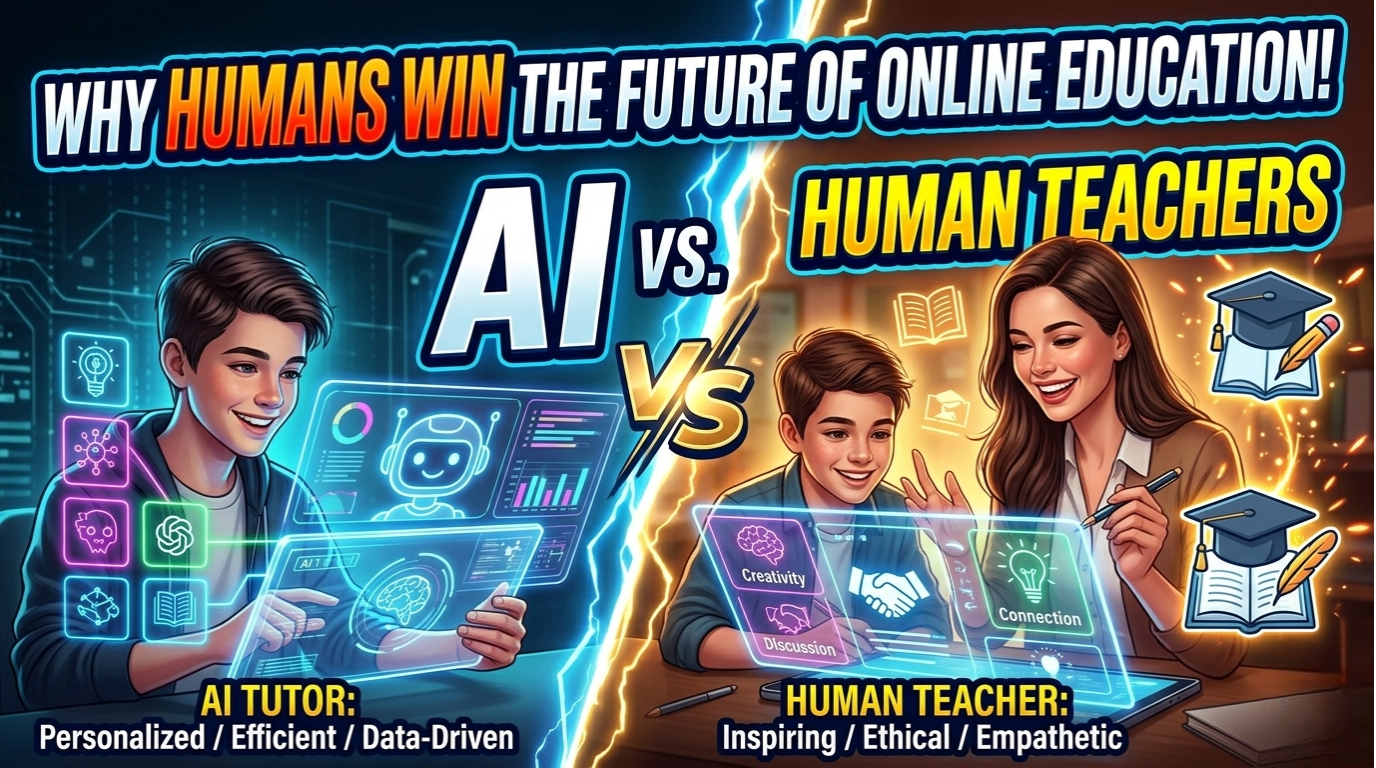
Yahan aapke blog ke liye ek high-quality, professional aur emotional-touch ke sath 1000-word ka blog post ready hai. Isme AI ki capabilities ko acknowledge karte hue Human Teachers ko clear winner sabit kiya gaya hai:
AI vs. Human Teachers: Why the Future of Online Education Belongs to Humans
The year 2026 has brought us to a thrilling turning point in technology. We now have AI tutors that can instantly draft personalized math problems, score essays in seconds, and track a student’s cognitive load based on how long they pause on a screen. With algorithms becoming incredibly smart, a burning question has taken over the educational world: Will Artificial Intelligence replace human teachers in online education?
While tech enthusiasts might argue that bots are the future, deep educational research and real-world data prove otherwise. AI is an exceptional assistant, but it can never be a replacement. When it comes to the true essence of learning, human teachers win the crown, hands down. Here is a deep dive into why human educators remain completely irreplaceable, and why the future of online education belongs firmly to them.
1. The Power of Empathy and Emotional Intelligence
Learning is not just a mechanical data transfer; it is an emotional journey. When an online student feels overwhelmed, stuck, or unmotivated, an AI algorithm sees it as a “lack of input.” A human teacher, however, reads between the lines.
-
The Human Edge: A human teacher notices the subtle frustration in a student’s voice during a live Zoom call or senses a drop in energy through their email communication.
-
The Reality of 2026: Even the most advanced LLMs (Large Language Models) in 2026 cannot feel genuine empathy. They can generate the words “I understand your frustration,” but it is a programmed response based on mathematical probabilities. A human teacher offers real reassurance, boosts a student’s self-esteem, and provides the emotional safety net required to handle academic failure.
2. Mentorship vs. Information Delivery
AI is brilliant at providing information. If you want to know the formula for standard deviation or need a summary of French history, a chatbot can give it to you in two seconds. But education is much more than information retrieval—it is transformation.
-
The Human Edge: Human teachers are mentors. They do not just teach a subject; they model work ethics, passion, and curiosity. They share their real-life experiences, professional struggles, and industry insights that no database contains.
-
Why AI Falls Short: AI can provide a code snippet, but it cannot inspire a computer science student to build a startup. It can correct grammar, but it cannot instill a deep passion for literature. Human educators give students a sense of purpose and direction, steering them toward successful career paths.
3. Cultivating Critical Thinking and Creativity
AI operates on patterns, historical data, and predefined rules. It is inherently predictive, not creative. If you ask an AI to solve a problem, it looks backward at existing data to find the answer.
“AI can teach you how to pass a test, but only a human teacher can teach you how to question the test itself.”
-
The Human Edge: Human teachers push students into the “Zone of Proximal Development” through deep, spontaneous debates. They challenge students with ethical dilemmas, abstract concepts, and real-world scenarios where there is no right or wrong answer.
-
The Reality: According to recent 2026 global education snapshots, over-reliance on AI tutoring has actually shown a decrease in students’ independent critical thinking skills during exams. Human teachers are the ones who foster cognitive independence, encouraging students to think outside the algorithm.
4. Unmatched Adaptability and Dynamic Classroom Control
Online teaching requires high-level situational awareness. A live virtual classroom is a dynamic, unpredictable environment where anything can happen.
-
The Human Edge: If a human teacher realizes that half of the online class looks confused during a complex web development lecture, they pivot instantly. They might drop the slide deck, pull up a fresh whiteboard, change their tone, or tell a relevant joke to re-engage the room.
-
Why AI Falls Short: AI is bound by its software architecture. It cannot read a room or dynamically adapt its entire teaching methodology on the fly based on a collective human mood. It follows rigid instructional design paths, which can make long-term online learning feel incredibly monotonous and dry.
5. Character Building and Ethical Guidance
In a digital world flooded with deepfakes, automated misinformation, and algorithmic biases, students do not just need to learn academic skills—they need to learn digital citizenship and ethics.
-
The Human Edge: Human teachers act as the moral compass of the classroom. They teach students accountability, the importance of original thought, and academic integrity. When a student makes a mistake or crosses an ethical boundary, a teacher uses it as a teachable moment for character development.
-
The Reality: AI has no moral agency. It cannot teach ethics because it does not possess a consciousness or values. Only a human can guide another human on how to navigate the complex social and moral realities of the modern world.
The 2026 Reality Check: What the Data Shows
Recent studies from major global educational institutions highlight a fascinating trend in 2026: The AI paradox. While students using generic AI tools to do their homework showed great practice scores, their final exam scores plummeted when the AI was removed.
Why? Because outsourcing cognitive effort to a machine creates a false sense of security. True learning requires desirable difficulties—struggles, confusion, and the eventual “aha!” moment. Human teachers understand this delicate psychological balance perfectly; they know exactly when to give a hint and when to step back and let the student struggle productively.
The Co-Pilot Framework: How the Future Actually Looks
Saying human teachers win doesn’t mean AI has no place. The ultimate future of online education is a symbiotic relationship, where AI serves as the ultimate administrative co-pilot, leaving the human teacher free to do what they do best: connect.
   [ AI Assistant ]  🚀 Handles: Grading, Lesson Templates, Data Analysis
          +
   [ Human Teacher ] 💡 Handles: Mentorship, Empathy, Critical Thinking, Inspiration
          =
   [ The Ultimate 2026 Learning Experience ]
By shifting the heavy administrative burden (like data entry, scheduling, and basic grading) over to AI, human teachers are experiencing a massive relief from burnout. They finally have more time to focus on one-on-one student interaction, deep-dive mentoring, and personalized emotional support.
Conclusion: The Irreplaceable Human Touch
AI is undeniably one of the greatest inventions in human history. It is a fantastic tool, a brilliant repository of data, and a highly efficient personal assistant. But a tool cannot be a teacher.
Education, at its core, remains an intrinsically human endeavor. It relies on connection, shared vulnerabilities, inspiration, and trust. As online learning expands globally in 2026, the demand for highly skilled, deeply empathetic human educators is higher than ever before.
AI will absolutely change how we teach, but it can never replace who teaches. In the grand battle of AI vs. Human Teachers, humanity wins by a landslide.