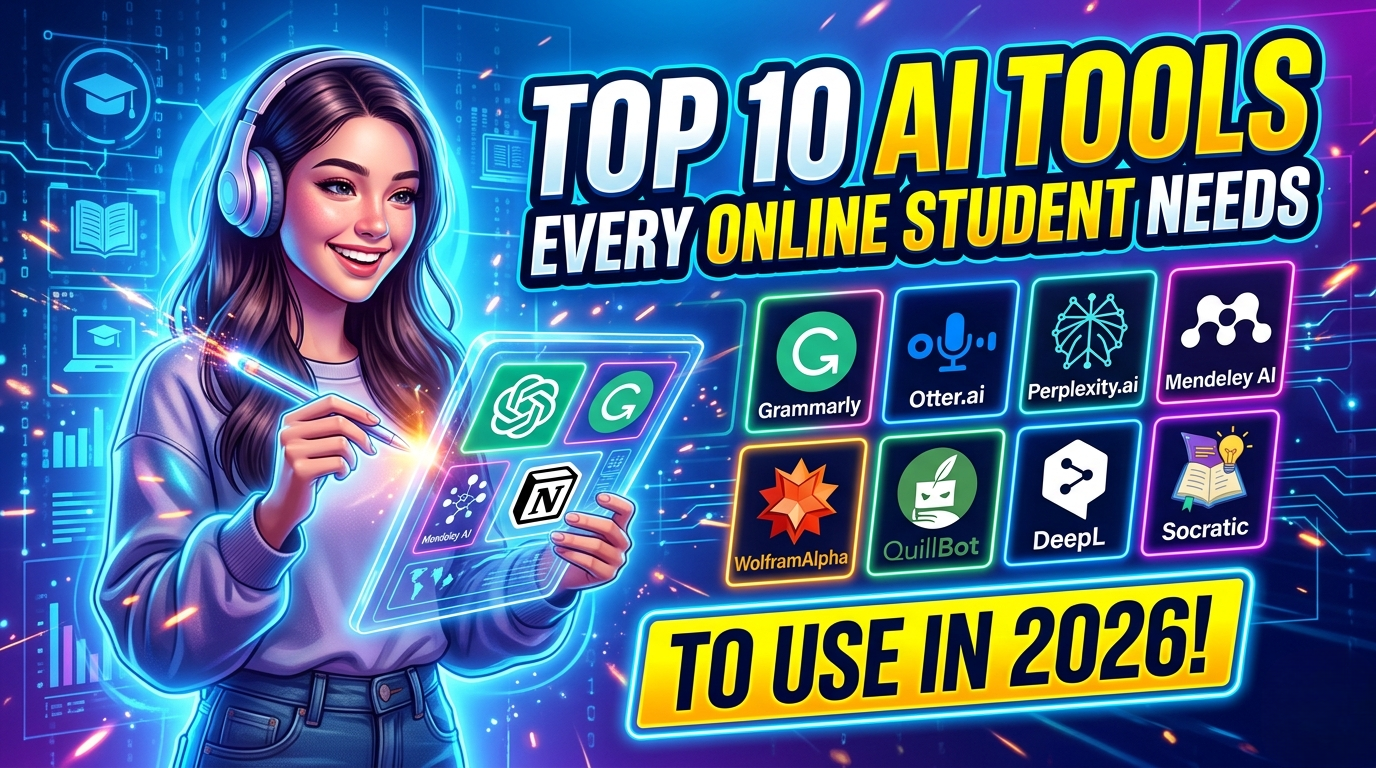
The landscape of online education has shifted dramatically. In 2026, being a successful online student is no longer just about sitting through recorded lectures and scrolling through dense PDFs. It is about speed, efficiency, and hyper-personalized learning.
With the rise of advanced multimodal AI and autonomous learning agents, students who know how to leverage the right tools are finishing assignments in half the time and achieving deeper comprehension. If you want to study smarter, stay organized, and ace your exams this year, here are the top 10 AI tools you need in your academic arsenal.
1. Google NotebookLM – Your Ultimate Smart Study Hub
If you are drowning in textbooks, research papers, and lecture transcripts, NotebookLM is your lifesaver. Unlike general AI models, NotebookLM allows you to upload your specific study materials (PDFs, Google Docs, or YouTube links) and creates a private AI clone that only answers questions based on your data.
-
Best For: Note management and deep document research.
-
Why You Need It: It eliminates hallucinations because it strictly sticks to your uploaded sources. In 2026, its ability to auto-generate interactive study guides, flashcards, and even dynamic audio briefings makes it an absolute must-have for exam revision.
2. ChatGPT (Edu & Premium Ecosystems) – The 24/7 Personal Tutor
ChatGPT remains the king of conversational learning. With the 2026 rollouts of highly localized educational frameworks (like the ChatGPT Edu initiatives deployed globally), it operates less like a simple text generator and more like a real-time Socratic mentor.
-
Best For: Explaining complex concepts and brainstorming.
-
Why You Need It: If you don’t understand a complex quantum physics theory or a piece of advanced code at 2 AM, you can ask ChatGPT to “explain it like I’m 10.” It can generate custom practice questions, simulate coding environments, and give you step-by-step guidance without giving away the direct answers too easily, ensuring you actually learn.
3. Perplexity AI – The Modern Academic Search Engine
Traditional search engines force you to click through ten different tabs to find one reliable fact. Perplexity AI changes the game by acting as a conversational research assistant that searches the live web, synthesizes the answer, and provides inline citations for every single claim.
-
Best For: Fact-checking and literature reviews.
-
Why You Need It: Academic integrity is paramount. Perplexity allows you to change its focus strictly to “Academic” mode, filtering out generic blog posts and pulling data purely from verified scientific journals and textbooks.
4. Grammarly – The Advanced AI Writing Co-Pilot
Moving far beyond basic spell-checking, Grammarly in 2026 uses highly contextual AI agents to evaluate the structural integrity, tone, and clarity of your essays.
-
Best For: Essay polishing and academic tone alignment.
-
Why You Need It: It helps you adapt your writing style seamlessly between casual discussions and formal, APA/MLA-compliant thesis papers. It also features a robust, integrated plagiarism detector to ensure your work remains completely original before submission.
5. Notion AI – Your All-in-One Academic Command Center
Staying organized is the hardest part of online learning. Notion AI embeds artificial intelligence directly into your daily workspace, converting messy lecture notes into structured, actionable items.
-
Best For: Task tracking and workspace organization.
-
Why You Need It: With a single click, Notion AI can scan a 3,000-word block of raw lecture notes and instantly extract a clean to-do list, generate a summary table, and flag upcoming deadlines into your calendar.
6. QuillBot – The Context-Aware Rephrasing Tool
When you are trying to synthesize research from multiple sources, accidentally copying a tone too closely is a major risk. QuillBot is an advanced paraphrasing tool that helps rewrite sentences while completely preserving the original meaning.
-
Best For: Rewriting text and adjusting sentence flow.
-
Why You Need It: Its 2026 upgrades include context-aware rephrasing modes that prevent the sentences from sounding robotic. It also includes an incredibly fast citation generator to help you build your bibliographies effortlessly.
7. Quizlet AI – Adaptive Active Recall
Flashcards have always been a staple of effective studying. Quizlet AI takes this a step further by utilizing machine learning to adapt to your specific memory retention rates.
-
Best For: Active recall and vocabulary/formula memorization.
-
Why You Need It: You can upload your raw notes, and the AI will instantly generate targeted flashcards and practice tests. The adaptive system tracks exactly which terms you are struggling with and loops them back more frequently until you have fully mastered them.
8. Gamma AI – Instant Presentation & Slide Generator
Group projects and presentations are common in online courses, but formatting slides can take hours. Gamma AI uses generative design to turn text prompts or document outlines into stunning, professional presentations in under a minute.
-
Best For: Creating presentations and visual reports.
-
Why You Need It: Instead of adjusting font sizes and alignment manually, you just type in your topic. Gamma AI builds a cohesive, beautifully designed slide deck that you can easily customize, saving you hours of design friction.
9. Khanmigo – The Ultimate Socratic Math & Science Coach
Developed by Khan Academy, Khanmigo is an AI tool built specifically for education. Unlike tools that just hand over the answer to a math problem, Khanmigo acts as an interactive coach.
-
Best For: Stem subjects, math, and step-by-step logic.
-
Why You Need It: If you get stuck on an algebra or calculus equation, Khanmigo guides your thinking with clever hints and questions, mirroring the style of an elite human tutor. It forces you to figure out the logic yourself, building long-term skills.
10. AskCodi – The Coding Student’s Best Friend
For any student taking modules in computer science, data analytics, or web development, coding blocks can be incredibly frustrating. AskCodi is a specialized AI assistant designed to explain, write, and debug code.
-
Best For: Programming and debugging.
-
Why You Need It: It supports dozens of languages (Python, JavaScript, C++, etc.). When your code throws a cryptic error, pasting it into AskCodi gives you an instant, clear explanation of why it failed and how to fix it inline.
The Ultimate AI-Powered Study Routine
To maximize your efficiency, you shouldn’t just use one tool—you should stack them together into a seamless workflow. Here is how a top-tier online student manages a project in 2026:
| Study Stage | Tool to Use | Purpose |
| 1. Research | Perplexity AI | Gather cited facts and credible data. |
| 2. Organization | NotebookLM & Notion AI | Store PDFs, ask questions, and build a task list. |
| 3. Drafting | ChatGPT & QuillBot | Brainstorm outlines and rephrase complex theories. |
| 4. Polishing | Grammarly | Check tone, eliminate typos, and verify originality. |
| 5. Presenting | Gamma AI | Instantly convert your final essay into a slide deck. |
A Quick Warning on Academic Integrity:
AI tools are meant to be your co-pilot, not the pilot. Use them to explain concepts, organize your workflow, and critique your writing. Relying on AI to write your entire assignment from scratch defeats the purpose of your education and violates institutional policies.
Conclusion
The secret to excelling at online learning in 2026 isn’t studying longer; it’s studying sharper. By incorporating these 10 AI tools into your daily routine, you can eliminate boring admin work, overcome writer’s block, and turn massive amounts of information into genuine, long-term knowledge. Pick two or three tools from this list to start with this week, and watch your productivity skyrocket!